
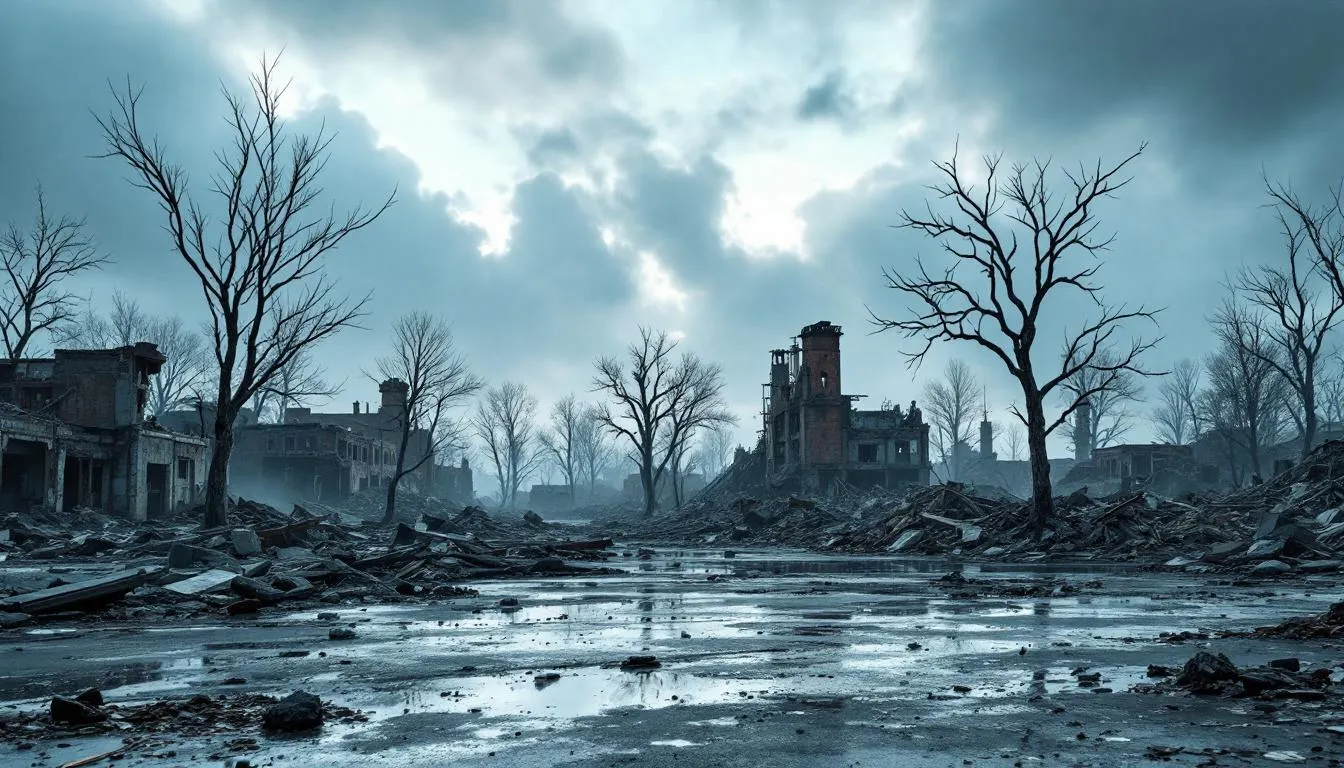
Death Toll Climbs as Tornadoes Rip Through Michigan and Oklahoma—Midwest Braces for Even Worse
At least four people are dead. Dozens more are trapped. And the worst isn't over yet.
A devastating outbreak of tornadoes tore across Michigan and Oklahoma on Friday, leaving a trail of mangled homes, crushed vehicles, and frantic rescue operations that stretched deep into the night. What started as scattered storm warnings in the afternoon escalated into a full-blown weather catastrophe by evening—with emergency officials warning that the real danger is only shifting, not fading.
In Michigan's southwestern corner, near the Indiana border, a particularly dangerous tornado carved through Union City and the Union Lake area around 4 p.m., killing at least three people and injuring at least 12 others. Another death was reported in nearby Cass County. Rescue crews were still digging through collapsed structures late Friday, pulling survivors from beneath mountains of debris as darkness fell. Governor Gretchen Whitmer activated the state's Emergency Operations Center, signaling how serious officials are taking the catastrophe.
Meanwhile, Oklahoma got hammered with a barrage of twisters. More than 15,000 customers lost power across the state—6,300 of them in the Tulsa metro area alone. Video footage showed transformers exploding like fireworks as tornadoes ripped power lines from their moorings. The Big 12 Wrestling Championship at Tulsa's BOK Center was evacuated as a precaution. Storm chasers documented homes reduced to splinters and entire blocks transformed into debris fields.
But here's the thing that keeps meteorologists and emergency managers up at night: this system is far from done.
The Threat Is Moving East—And It's Bringing Company
By Saturday morning, the tornado threat will barrel across the Midwest like an unwelcome house guest who won't leave. Storms are expected to push northeast out of Oklahoma, sweeping through Arkansas, Kansas, Missouri, and Iowa. Cities including Dallas, Kansas City, and Milwaukee remain under tornado watch through midnight—with meteorologists warning that nighttime tornadoes are particularly deadly because people are asleep and have less warning.
Meteorologist Sara Tonks from the Weather Prediction Center laid out the grim reality: "Multiple cities will remain under at least a level 2 out of 5 risk of severe weather until after midnight local time." That's not a minor threat. That means conditions are primed for more twisters, damaging hail, and winds that can peel the roof off a house.
By Saturday afternoon, the entire eastern Great Lakes region, Tennessee Valley, and the broader South face the threat. This isn't localized turbulence—it's a coast-to-coast weather system that's going to affect millions of Americans over the next 24 to 48 hours.
What makes this system particularly vicious is the setup. Temperatures across Michigan are running 30 to 35 degrees above normal for early March. That warm, moist air is clashing with cooler air still hanging around in the northern United States. When those two air masses collide, they don't just produce rain. They produce rotation. They produce the kind of atmospheric violence that can destroy entire blocks in seconds.
Michigan's Nightmare: Trapped Under Rubble
Storm chasers who arrived at the devastation in Union City, Michigan, described scenes so nightmarish that some stopped chasing the storm to help dig people out of the wreckage. Homes were leveled. Businesses were obliterated. Cars were twisted like aluminum cans.
The Branch County Sheriff's Office confirmed the deaths and injuries, and preliminary assessments suggest at least one structure completely collapsed—trapping residents beneath tons of wood, drywall, and debris. Emergency responders were working through the night with floodlights and heavy equipment, racing against the clock to find survivors before the rescue window closes.
For residents in Michigan, this hits differently. Tornadoes aren't rare in the state, but the intensity and speed of this one—rated as a "Particularly Dangerous Situation" by meteorologists—caught many people off guard. One moment, people were going about their Friday evening. The next, their homes were gone.
Oklahoma Already Bleeding from Thursday's Tornadoes
The system didn't wait until Friday to kill. On Thursday night, a mother and her teenage daughter were killed when a tornado slammed into their van near Fairview, Oklahoma, along State Highway 60. They were just driving home when the twister hit.
The National Weather Service teams in Norman, Oklahoma, spent Friday conducting damage surveys from Thursday's tornadoes. They've already preliminarily rated three separate tornadoes as EF1 and EF2 strength—the kind of winds that can snap trees like toothpicks and turn a house into rubble. A fourth tornado in Grant County is believed to have touched down, but teams haven't reached that area yet.
An EF2 tornado that moved from Helena toward Jet, Oklahoma, is still being surveyed. Authorities warn that the final tally could be worse once all the damage is assessed.
March Tornadoes Are Getting Worse—And Nobody Fully Understands Why
Here's what's alarming for meteorologists and climate experts: March has become the deadliest month for tornadoes in recent years, and the trend is accelerating.
In 2025 alone, there were 300 tornado reports in March. That's not final. That's a preliminary number. And it's staggeringly higher than any other March in recorded history. Three of the last four Marches have produced more than 200 tornadoes. March 2022 holds the record with the most confirmed tornadoes, and 2023 wasn't far behind with 204.
The reason? Spring is when warm, moist air from the Gulf of Mexico clashes with cooler air still locked over the northern United States. It's the classic recipe for severe weather. But the clashes are becoming more intense. The temperature differences are widening. The moisture is getting more abundant.
The Lower Mississippi River Valley and the Deep South have historically been tornado hotspots in March. But now, tornadoes are spinning up across the Central Plains, the Midwest, and even as far north as Michigan with alarming regularity. The geographic range of the threat is expanding.
Flooding Is Coming Too—And Much of the South Is Already Bone Dry
If tornadoes weren't enough, this system is bringing another hazard that often gets overlooked: catastrophic flooding.
The same storms producing the twisters are dumping heavy rain across regions already parched by drought. According to the National Drought Mitigation Center, more than 80% of the South is currently under at least a moderate drought. Dry ground doesn't absorb rain well. When you dump inches of rain onto baked earth, you get flash flooding—the kind that sweeps vehicles off roads and traps people in underpasses.
The Weather Prediction Center has issued a level 2 out of 4 threat for excessive rainfall across the ArkLaTex region through Saturday morning. Later Saturday, the flooding threat expands to include parts of Alabama and Tennessee. The culprit is multiple rounds of heavy rainfall from storms moving parallel to a cold front. Translation: repeated waves of rain will hammer the same areas, with little chance for ground saturation to ease.
For folks in that zone, it's a double hammer blow. First, the tornado risk. Then, if the storms miss you, flash flooding could still wreck your day—or worse.
What Americans Need to Know Right Now
If you're in a watch or warning zone, the difference between the two is life or death. A watch means conditions could lead to severe weather—so prepare. A warning means dangerous weather is happening right now—so take action.
For those in multistory homes, sleep on the lowest floor. Interior rooms—bathrooms, closets—are safer than bedrooms near exterior walls. Debris doesn't care about your bedroom window. A helmet and sturdy shoes in your emergency kit could be the difference between walking away with bruises and walking away in a body bag.
Have multiple ways to get warnings. Your smartphone might die. Your power might go out. A battery-powered NOAA Weather Radio sits there 24/7, waiting to scream at you when danger arrives. Keep flashlights and extra batteries nearby.

0 Comments