
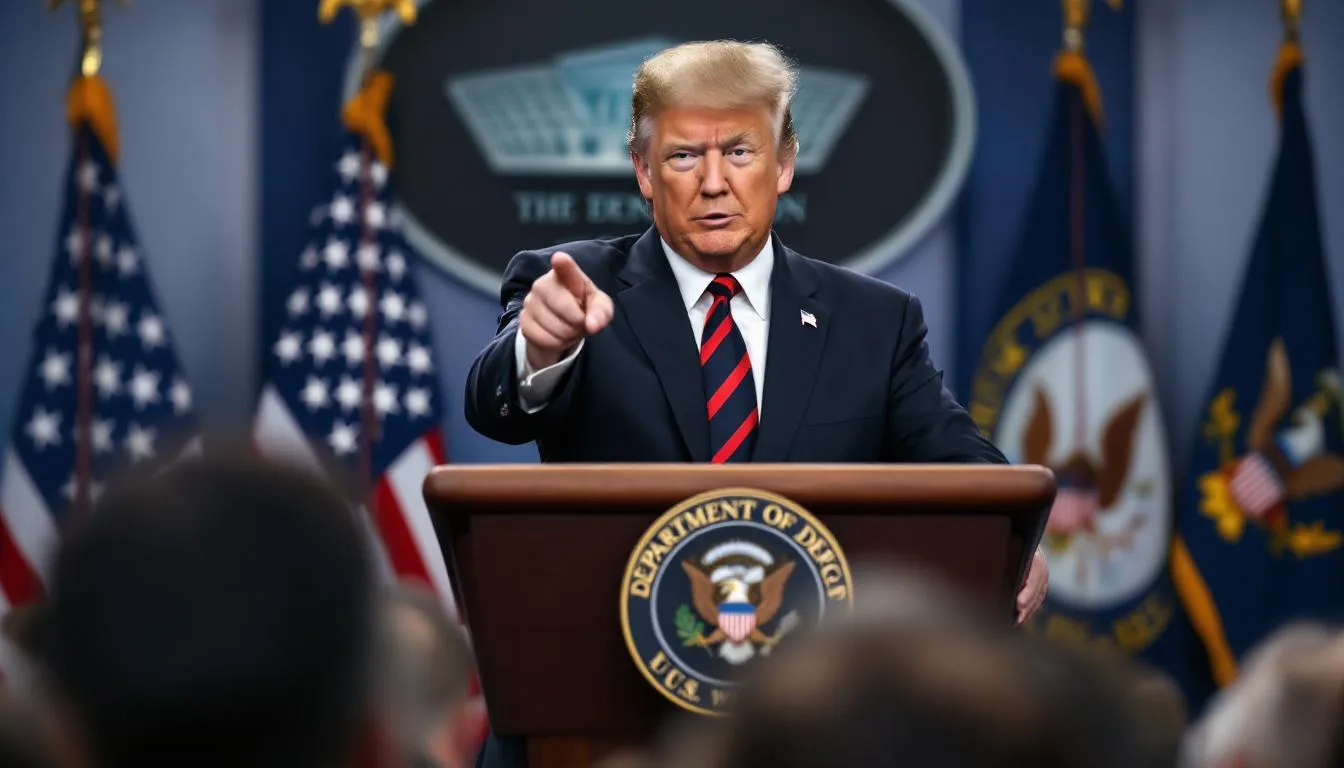
Defense Secretary Pete Hegseth speaking at Pentagon podium during press briefing
Defense Secretary Hegseth's War Talk Sounds Like an Action Movie. Scholars Say That's by Design—and It's Dangerous.
Defense Secretary Pete Hegseth isn't playing by the old playbook. When he took the podium in March 2026 to discuss the first days of U.S.-Israeli combat operations in Iran, he didn't sound like James Mattis—the measured, careful general who preceded him. He sounded like a guy who'd watched too many Marvel movies and decided military strategy was just another arena for trash talk.
"They are toast and they know it." "We play for keeps." "President Trump got the last laugh."
The shift wasn't accidental. It's part of a calculated rebranding of how power speaks to Americans in 2026—and it matters more than you think.
The Mattis Contrast: When Adults Ran the Pentagon
Rewind to 2017. Secretary of Defense James Mattis held a press conference about intensifying combat operations against ISIS. His tone was grave. He talked about getting "the strategy right." He emphasized "the rules of engagement." He promised the American people that protecting innocents wasn't negotiable.
It was the language of someone carrying the weight of sending people to die.
Hegseth threw all that out the window. Within days of the Iran operation, he was dismissing concerns about long-term geopolitical strategy with a shrug and a smirk. "No stupid rules of engagement, no nation-building quagmire, no democracy building exercise, no politically correct wars," he declared on March 2, 2026. "We fight to win."
When reporters pushed back—asking about casualties, strategy, exit plans—he had a ready answer: Stop being so negative. "This is not Iraq," he barked at the media. You're just trying to make Trump look bad.
Two days later, he doubled down. "Dominance." "Control." Those were his buzzwords. And when the press dared to ask about human costs? He blamed the media for liberal bias and anti-Trump hatred.
"Tragic things happen; the press only wants to make the president look bad," he shrugged. Then came the kicker: "This was never meant to be a fair fight. We are punching them while they are down, as it should be."
[IMAGE_1]What a Communication Scholar Sees in Hegseth's Words
A decade of studying MAGA rhetoric reveals something unsettling about Hegseth's approach: he's not accidentally breaking the rules. He's deliberately torching them.
When the U.S. goes to war, there's an unspoken contract. The president and defense secretary must convince the public that the action is necessary. They do this by laying out facts, explaining strategy, and speaking with the gravitas that comes from sending people into combat zones. They earn trust through restraint and seriousness.
Hegseth rejected that contract entirely.
During the first week of the Iran campaign, his press briefings read like a WWE heel's trash-talk session. He threw around phrases meant for military recruitment videos, not public defense of policy. "They are toast." "We play for keeps." "Trump got the last laugh." Each one delivered with the swagger of someone who'd never lost a barroom argument.
The tone? Haughty. The attitude toward death? Casual, almost giddy. The preoccupation with "domination"? Hypermasculine and unapologetic.
Pentagon observers were stunned. This wasn't how defense secretaries talked to Americans.
How Trump's Cabinet Changed the Game
Here's what makes this moment different from Trump's first term.
Back then, the rule-breaking was mostly Trump's thing. He'd say outrageous stuff, and his cabinet members—Mattis included—would quietly work to rein him in. They'd exchange worried glances, brief against him in background calls, and try to steer the ship back to normalcy.
Not anymore.
Trump's second cabinet isn't staffed with generals trying to be the adults in the room. It's filled with media personalities. Kash Patel came from Fox News circles. Sean Duffy made his name on reality TV. Mehmet Oz built a career on television spectacle. And Hegseth? He's a Fox News personality who transitioned directly into the Pentagon.
Loyalty is now the only qualification that matters. Not experience. Not restraint. Not respect for institutional norms. Just loyalty to Trump and the MAGA worldview.
That worldview has a language all its own. It rejects what it sees as "elite" expectations of how officials should behave. In far-right media culture, "owning" your enemy is currency. "Dominating" them is the goal. "Triggering" the liberal media is a bonus round.
When you spend years in that ecosystem, traditional political language starts to feel like a straitjacket. The old rules of engagement look emasculating. Restraint looks weak.
[IMAGE_2]Trump picked Hegseth specifically because he performs "the big man" role perfectly. He speaks like the guy who doesn't care what anybody thinks. He's not bound by norms. He says what he wants, when he wants, without an apology filter.
And that's terrifying when the "big man" is deciding how to wage war.
The "Kill Talk" Strategy: Making War Sound Like a Video Game
Hegseth's language choices reveal something darker than mere showmanship. He's using what's called "kill talk"—a verbal strategy typically deployed by military recruiters to strip the enemy of humanity and obscure the actual costs of violence.
When he grinned and declared, "Turns out the regime who chanted 'Death to America' and 'Death to Israel' was gifted death from America and death from Israel," that wasn't clever wordplay. It was kill talk. It was turning mass death into a punchline. A victory lap.
Watch his press conferences and count the words he repeats: "death," "killing," "destruction," "control," "warriors," "dominance." Over and over. Each repetition frames violence in heroic, almost mythological terms—completely detached from what war actually looks like. Detached from the screaming. The blood. The families getting phone calls that don't have happy endings.
Hegseth spoke to the public the way a squad leader speaks to new recruits. And he clearly enjoyed dispensing death and glorifying war. When asked about strategy beyond winning? Crickets.
In the MAGA media world, winning is all that matters. Full stop. If winning's the only goal, then war isn't a grave national decision requiring careful deliberation. It's a game. A test of masculine fortitude.
The White House made that literal. They posted a video of airstrikes on Iran interspersed with "killstreak animations" from Call of Duty: Modern Warfare—the video game where players rack up points by executing enemies. In the game, you get rewarded for mass kills. The White House seemed to think real war deserved the same aesthetic treatment.
[IMAGE_3]That's not an accident. That's a choice. A choice to gamify violence and obscure its costs. A choice to speak about war the way a teenager speaks about a video game.
What This Means for American Democracy
When the government goes to war, the public has a right to straight answers. They deserve to hear about strategy, costs, and risks. They deserve an explanation that respects their intelligence and their stake in the outcome.
Instead, they got a defense secretary who treated serious questions as personal attacks. Who dismissed concerns about casualties as fake news bias. Who spoke about dominance and control like he was reading lines from an action screenplay.
The contemptuous hypermasculinity here isn't just annoying. It's a fundamental rejection of democratic accountability. When Hegseth's tone conveyed "nobody's going to tell me how to talk about this," it wasn't a personality quirk. It was a statement: the public doesn't get explanation or comfort. You get what we decide to give you, and you'll shut up about it.
That's the real story underneath the bombastic language and the one-liners. This

0 Comments